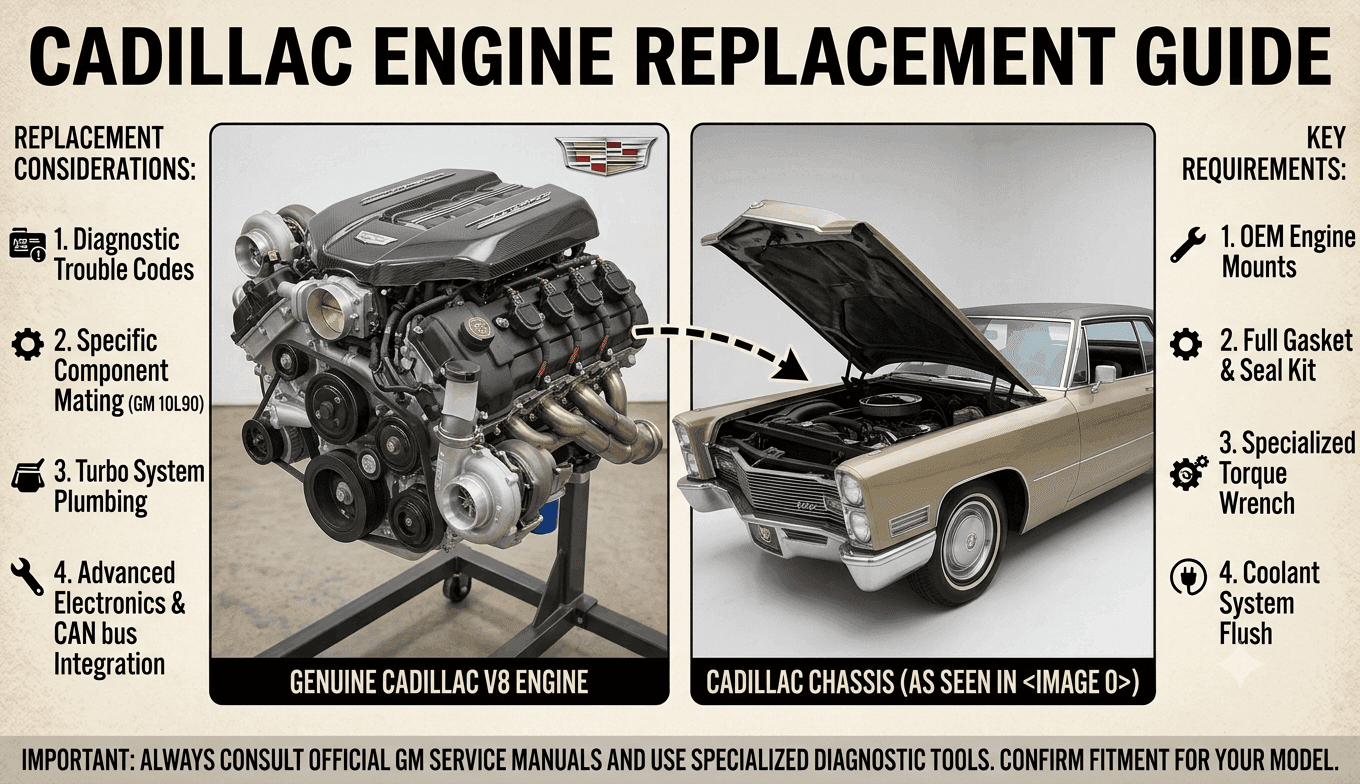
Cadillac Engine Replacement Guide | Used Cadillac Engines
Learn how to choose the right used Cadillac engine with this complete replacement guide. Covers Escalade, CTS, ATS, XT5, CT5, DTS, XTS, engine codes, VIN matching, common failures, and expert buying tips.

James Watson
Engines Expert
Cadillac Engine Replacement Guide | Used Cadillac Engines
Learn how to choose the right used Cadillac engine with this complete replacement guide. Covers Escalade, CTS, ATS, XT5, CT5, DTS, XTS, engine codes, VIN matching, common failures, and expert buying tips.
Complete Model-by-Model Reference for DTS, CTS, Escalade, ATS, XT5, CT5 and Every Major Cadillac Platform
Cadillac has been building premium American vehicles for over 120 years, and the engines powering today's Escalade, CT5, XT5, ATS, CTS, DTS, and SRX represent some of the most sophisticated powertrains General Motors has ever produced. When one of these engines fails, the replacement decision carries real financial weight. New OEM Cadillac engines are expensive. Dealer labour rates amplify that cost significantly. And choosing the wrong replacement engine wrong generation, wrong engine code, wrong emissions specification turns an already stressful situation into a costly mistake.
At InfoAutoParts by Rock AutoCare, we supply quality-tested used Cadillac engines for every major model and platform across the United States. Every engine is compression-tested, oil-pressure verified, and matched to your specific vehicle by year, model, trim, engine code, and VIN before it ships. A warranty is included on every unit. We deliver to all 50 U.S. states directly to your door or your mechanic's shop.
This guide covers every major Cadillac engine platform, the specific failure patterns that drive replacement demand, the engine codes you need to know, and exactly what to look for when sourcing a replacement.
Why Cadillac Engine Replacement Costs More Than Most People Expect
Cadillac engineers its vehicles to a higher specification than most domestic brands, and that engineering sophistication carries a direct cost premium when something goes wrong. A new OEM Cadillac engine costs between $5,000 and $14,000 depending on displacement, generation, and whether the vehicle is a standard model or an M-equivalent like the CT5-V Blackwing. Dealer installation labor at Cadillac's typical shop rate of $180 to $230 per hour adds $1,500 to $3,500 on top of that.
A quality-tested used Cadillac engine from InfoAutoParts delivers the same factory-matched displacement, emissions compliance, and performance specification for 50% to 70% less than a new OEM unit with warranty included and VIN-verified fitment confirmed before the engine leaves our facility.
The Cadillac owner who understands exactly which engine their vehicle uses, what the specific failure was, and what a correct replacement looks like makes a significantly better purchasing decision than one who relies on general model-year guidance alone. This guide gives you that understanding.
Used Cadillac DTS Engine for Sale — Northstar 4.6L V8
The 2006–2011 Cadillac DTS is one of the most searched used Cadillac engine categories in the United States driven almost entirely by the Northstar 4.6L V8's well-documented head bolt thread failure and the resulting head gasket breach that affects a significant percentage of high-mileage DTS examples.
The DTS uses a front-wheel-drive transverse platform, the GM K-body, with the Northstar mounted sideways driving through an integrated transaxle. This platform architecture means only the Northstar 4.6L DOHC engine is a direct OEM-matched replacement no alternative engine family can be substituted without fundamental platform modification.
VIN digit 8 for DTS:
Y = LD8 275 HP standard output
9 = L37 291 HP performance output
These two codes produce meaningfully different power outputs from the same displacement through different camshaft profiles and intake manifold calibration. Installing an LD8 into a vehicle originally equipped with an L37 returns less power than the driver expects. Installing an L37 into an LD8 vehicle works mechanically but may trigger ECU adaptive issues if the control module is not reprogrammed. Always verify your 8th VIN digit and match the replacement engine code exactly.
Most Common Cadillac DTS Engine Failure Reasons:
The Northstar 4.6L's most documented failure is head gasket breach caused by aluminium head bolt thread stripping in the aluminium block. Over years of thermal cycling, the aluminium-on-aluminium thread engagement loses clamping force, the head gasket seal fails, and combustion gases enter the cooling system. The progression is predictable unexplained coolant loss, bubbling in the coolant reservoir, white exhaust smoke under load, and eventually engine overheating that if allowed to continue causes head warping, bearing damage, and complete engine failure that makes replacement the only practical path forward.
Secondary failure patterns include water pump failure causing sudden coolant loss, thermostat housing cracking at high mileage, and occasional timing drive chain wear on very high-mileage examples beyond 180,000 miles.
Every used DTS Northstar engine at InfoAutoParts is inspected for:
Oil and coolant contamination (the primary indicator of prior head gasket breach)
Compression across all 8 cylinders against Northstar OEM specifications
External coolant leak points at the water pump, thermostat housing, and intake manifold
Oil condition and evidence of prior overheating events
Used Cadillac CTS Engine for Sale — 3.6L V6 and 2.0T Options
The Cadillac CTS is the most production-diverse Cadillac model in terms of engine options spanning multiple generations, multiple displacements, and both naturally aspirated and turbocharged configurations across a 15-year production run. Identifying the exact engine your CTS uses before sourcing any replacement is non-negotiable because the fitment differences between generations are significant.
2003–2007 Cadillac CTS Engine (First Generation)
The first-generation CTS used the 3.2L LY9 V6 in base trim and the 3.6L LY7 V6 in the CTS-V predecessor. Both are longitudinal rear-wheel-drive engines on GM's Sigma platform.
VIN digit 8: N = LY9, T = LY7, S = LS6
Most common failure: Timing chain wear on the LY7 at higher mileage, camshaft actuator solenoid failure causing rough idle and check engine codes P0014 and P0017, and oil consumption on high-mileage LY9 examples.
2008–2014 Cadillac CTS Engine
The second-generation CTS introduced the updated 3.0L LF1 and 3.6L LFX engines alongside the high-performance 6.2L LSA supercharged V8 in the CTS-V. This generation is the highest-volume CTS engine replacement request we handle.
VIN digit 8: 7 = LF1, 7 or V = LFX, P = LSA
Most common failure: Timing chain stretch on the LFX the same failure pattern affecting the ATS and SRX with this engine. Cold-start rattle lasting 2 to 5 seconds is the earliest warning sign. Codes P0008, P0009, P0016, and P0017 confirm cam-to-crank correlation errors from chain wear. Every LFX unit at InfoAutoParts is timing-chain inspected before listing.
2014–2019 Cadillac CTS Engine (Third Generation)
The third-generation CTS used the updated LFX and the new turbocharged 3.6L LF3 twin-turbo in the CTS Vsport alongside the 6.2L LT4 supercharged V8 in the CTS-V.
VIN digit 8: V = LGX, Y = LF3, R = LT4
Most common failure: The LF3 twin-turbo 3.6L is the most specialized sourcing request in the CTS lineup turbocharger failures, intercooler issues, and high-pressure fuel pump wear are the primary replacement drivers. Every LF3 at InfoAutoParts is inspected for turbocharger shaft play, boost pressure integrity, and fuel system component condition before shipping.
Used Cadillac ATS Engine for Sale — 2.0T and 3.6L Options
The 2013–2019 Cadillac ATS is Cadillac's compact sports sedan built on a shortened version of the Sigma rear-wheel-drive platform that also underpins the CTS. The ATS offers two primary engine configurations: the turbocharged 2.0L LTG four-cylinder and the 3.6L LFX V6.
VIN digit 8: X = LTG, V = LFX, Y = LF4
Most common failure on ATS LTG: Oil consumption due to piston ring design particularly on 2013 to 2015 examples where the ring seating process was sensitive to early oil change discipline. Cadillac issued a technical service bulletin acknowledging LTG oil consumption. Engines consuming more than one quart per 2,000 miles without any external leak are exhibiting this failure pattern. Every LTG at InfoAutoParts is compression-tested per cylinder to verify ring integrity before listing.
Most common failure on ATS LFX: Timing chain rattle on cold start identical to the CTS LFX pattern. The ATS-V LF4 twin-turbo replacement is our most specialized ATS request turbo failures and charge pipe cracking under hard use are the primary drivers.
Used Cadillac Escalade Engine for Sale — 6.2L V8 EcoTec3
The Cadillac Escalade is our single highest-volume Cadillac engine replacement category. The Escalade's 6.2L V8 engine codes L86 (2015–2018) and L87 (2019–2024) share their AFM lifter failure vulnerability with the same engine in the Chevrolet Silverado and GMC Yukon, driving massive and consistent replacement demand across all three platforms simultaneously.
VIN digit 8: 8 = L86, J = L87, L = LM2 Duramax
The critical difference between L86 and L87: The L86 uses AFM (Active Fuel Management) with 4 deactivating cylinders. The L87 uses DFM (Dynamic Fuel Management) with 17 deactivation patterns. The L87's DFM system is more sophisticated and carries improved reliability over the L83/L86 generation. When ordering a replacement, your model year determines which code you need they are not directly interchangeable without ECU reprogramming.
Most common Escalade engine failure reason:
AFM lifter collapse is the defining failure of the Escalade 6.2L V8. The AFM system uses hydraulically collapsing lifters in four of eight cylinders to disable those cylinders during light-load highway cruising. These lifters rely entirely on consistent oil pressure and full-synthetic oil quality to function correctly. When oil pressure drops, oil quality degrades between extended change intervals, or the lifter mechanism fatigues from millions of deactivation cycles, the lifter collapses at the wrong moment and drops metal debris into the engine oil. This debris circulates through every lubricated surface in the engine before the next oil change, damaging camshaft lobes, bearings, and oil pump pickup screen in a cascade that makes full engine replacement the most practical solution.
Symptoms that confirm Escalade AFM lifter failure:
Persistent engine tick or knock at idle that does not clear with temperature
Misfire codes on specific cylinders served by failed lifters
Rapid oil consumption between changes
Metal particles visible in drained oil
Collapsed pushrod visible during valve cover inspection
Every L86 and L87 engine at InfoAutoParts is specifically inspected for AFM lifter condition, camshaft lobe integrity, and oil contamination before listing. We also advise customers on AFM delete kits replacing all eight AFM lifters with solid roller lifters and disabling cylinder deactivation through ECU tuning to prevent the same failure mode from recurring in the replacement engine.
Used Cadillac XT5 Engine for Sale — 3.6L LGX V6
The Cadillac XT5 is Cadillac's best-selling crossover SUV, replacing the SRX in 2017. It uses the updated 3.6L LGX V6, an improved successor to the LFX that addressed the LFX's timing chain sensitivity through a revised tensioner design and improved chain guide material.
Most common XT5 engine failure reason: The LGX carries a significantly cleaner reliability record than the LFX it replaced. Primary replacement drivers are high mileage wear, collision damage, and oil consumption on very high-mileage examples. The LGX does not share the LFX's cold-start timing chain rattle issue in properly maintained examples, making it one of the more reliable Cadillac engines on the used market when service history is documented.
Every LGX sourced for XT5 replacement at InfoAutoParts is oil-pressure tested, compression verified, and VTC (Variable Timing Control) actuator inspected before shipping, the VTC actuator being the primary wear item in the LGX's variable valve timing system at higher mileage.
Used Cadillac CT5 Engine for Sale — 3.6L LGX and 2.0T LSY
The 2020–2024 Cadillac CT5 is Cadillac's current flagship sedan, replacing both the CTS and the ATS in Cadillac's restructured lineup. It offers two engine options in standard trim and the LT4 supercharged V8 in the CT5-V Blackwing specification.
VIN digit 8: V = LGX, X = LSY, R = LT4
Most common CT5 engine replacement reason: The CT5 is a newer platform, and high-mileage failures are less common than with older Cadillac models. Primary replacement requests come from collision-damaged vehicles and early LSY turbo failures, the LSY being the newest addition to the Cadillac engine lineup with a shorter documented reliability history than the LGX. The LT4 supercharged V8 replacement is our most specialized CT5 request and requires precise VIN matching to confirm supercharger specification and ECU calibration.
Used Cadillac SRX Engine for Sale — 3.6L LFX and 2.8T
The Cadillac SRX (2010–2016) was Cadillac's midsize crossover before the XT5 replaced it. The second-generation SRX used the 3.6L LFX V6 and a turbocharged 2.8L variant in earlier trims.
Most common SRX engine failure: The LFX timing chain failure is as prevalent in the SRX as in the ATS and CTS with this engine cold-start rattle, codes P0008 to P0019, and eventual catastrophic chain jump at very high mileage are the same failure progression. The LF1 3.0L develops throttle body issues and camshaft actuator failures more frequently than the LFX at comparable mileage.
Used Cadillac XTS Engine for Sale — 3.6L V6
The 2013–2019 Cadillac XTS is Cadillac's front-wheel-drive flagship sedan built on the same GM E platform as the Chevrolet Impala but positioned at the top of Cadillac's mainstream lineup above the DTS it replaced.
VIN digit 8: V = LFX, Y = LF3
Most common XTS engine failure: The LFX in the XTS presents the same timing chain failure pattern as in the SRX, ATS, and CTS. The LF3 twin-turbo in the XTS Vsport is less commonly replaced, but when it fails, turbocharger and high-pressure fuel pump issues are the primary causes. Every LFX XTS engine at InfoAutoParts is timing chain-inspected. Every LF3 is turbocharger-evaluated before listing.
How to Choose the Right Used Cadillac Engine — Step by Step
Step 1 — Locate Your VIN Your 17-character VIN is on the lower-left corner of your dashboard visible through the windshield, on your driver's door jamb sticker, and on your insurance and registration documents. The 8th character is your engine code. This single character eliminates all engine compatibility guesswork when cross-referenced against the table above.
Step 2 — Confirm Your Generation Cadillac has made significant changes within the same model nameplate across generations. A 2010 CTS and a 2016 CTS are different platforms with different engines. A 2014 Escalade and a 2018 Escalade use different 6.2L engine codes. Always provide your exact model year, not just the model name.
Step 3 — Identify the Failure Mode Knowing why your engine failed helps our team source the most appropriate replacement. Timing chain failure in an LFX means we prioritize checking chain condition in the replacement. AFM lifter failure in an Escalade means we inspect lifter condition and advise on delete kit options. Northstar head gasket failure means we verify oil and coolant cross-contamination history in any candidate replacement unit.
Step 4 — Confirm Drivetrain Configuration Several Cadillac models are available in both front-wheel-drive and all-wheel-drive configurations and while the engine code may be identical, AWD variants sometimes require different accessory drive configurations and sensor placements. Confirm your drivetrain when requesting a quote.
Step 5 — Tell Us Your Mileage Target For Escalades used for towing, ATS-V track cars, and CTS Vsport daily drivers lower mileage units are worth prioritizing even at higher cost. For a standard XT5 or XTS used for comfortable daily commuting, a mid-range mileage unit from a well-maintained source offers excellent value without premium pricing.
Our 8-Stage Cadillac Engine Inspection Process
Every used Cadillac engine at InfoAutoParts by Rock AutoCare passes this inspection before listing or shipping:
Visual Inspection: External check for cracks, corrosion, coolant staining, oil sludge, physical damage, and missing hardware
Compression Test: Every cylinder verified against Cadillac OEM specifications for the specific engine code
Oil Pressure Test: Internal pressure confirmed within the manufacturer's safe operating range
Oil and Coolant Cross-Contamination Check: Critical on all Northstar units and any engine from a vehicle with overheating history
Timing Chain Inspection: Chain stretch, tensioner condition, and guide integrity verified on all LFX, LY7, and LF1 units
AFM Lifter Assessment: Lifter condition specifically evaluated on all L86, L87, and LSA supercharged V8 units
Turbocharger Evaluation: Shaft play, seal integrity, and boost function tested on all LTG, LF3, LF4, and LSY turbo units
VIN Cross-Check and Documentation: Engine code verified against your vehicle VIN, mileage logged, inspection status tagged before dispatch
Need the Right Part?
Get a free, no-obligation quote from AutoKing specialists.
Frequently Asked Questions
The 3.6L LGX V6 introduced in 2016 carries the strongest reliability record of any current Cadillac engine addressing the timing chain sensitivity of the LFX it replaced through improved tensioner design and revised chain guide material. The LGX powers the XT5, CT5, and CT6 and in properly maintained examples has a clean failure history. The 6.2L L87 EcoTec3 in the 2019 and later Escalade is also significantly improved over the L86 in AFM reliability through its DFM system.
Pricing depends on model, engine code, and mileage. Used Northstar 4.6L engines for the DTS typically range from $1,200 to $2,800. The 3.6L LFX for ATS, CTS, and SRX ranges from $1,000 to $2,500. The Escalade 6.2L L86 and L87 range from $2,000 to $4,500. The LT4 supercharged V8 for the CTS-V and CT5-V Blackwing starts at $4,500 and ranges higher based on mileage and availability. Contact InfoAutoParts for a free same-day quote on your specific model.
Yes, for DTS and STS vehicles in otherwise solid mechanical and cosmetic condition. A quality-tested used Northstar is the only practical direct replacement for the DTS's transverse front-wheel-drive platform. When the replacement unit is properly sourced, contamination-free, and compression-verified, it provides reliable performance at a fraction of the cost of a remanufactured unit.
Both are 3.6L DOHC V6 engines but from different generations. The LFX (2012–2016) has well-documented timing chain sensitivity that makes oil change discipline critical. The LGX (2016+) uses a revised timing chain tensioner design and improved chain guide material that significantly reduces the cold-start rattle and premature chain wear concern. The LGX also produces slightly more power and has better fuel economy through improved VVT calibration. They are not directly interchangeable without ECU adaptation.
Provide your vehicle's year, model, trim, VIN, and engine code if known. For Escalade owners, specify whether your vehicle is an L86 or L87 (confirmed by VIN digit 8). For CTS and ATS owners, specify whether your 3.6L is an LFX, LGX, or LF3 twin-turbo. For DTS owners, confirm whether your Northstar is the LD8 or L37 variant. Our team handles VIN cross-checking as a mandatory step before processing any Cadillac engine order.
Most orders are dispatched within 1 to 3 business days of order confirmation. We ship to all 50 U.S. states via freight carriers experienced with heavy engine shipping. Estimated delivery windows are confirmed at the time of order. We deliver directly to your door or to your mechanic's shop.
Still have questions?
Our specialists are ready to help — no bots, no scripts.