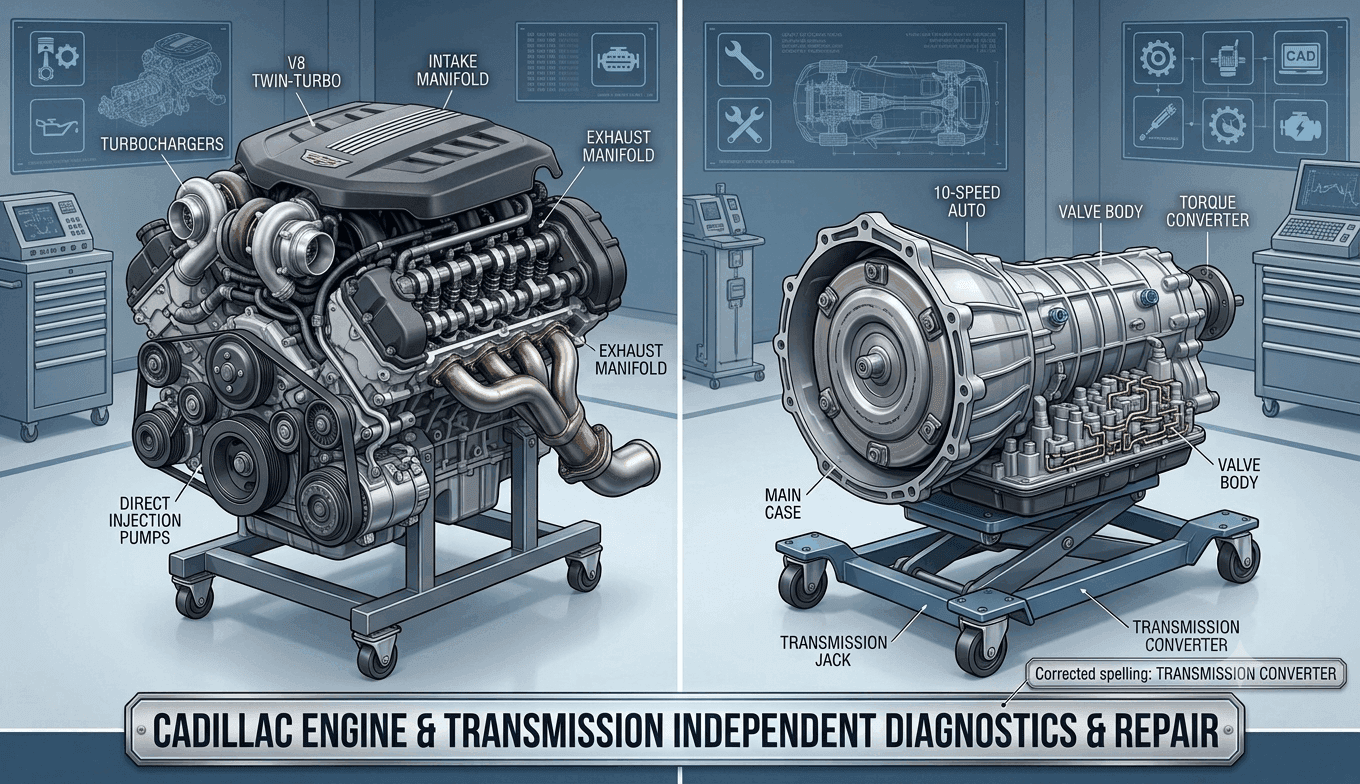
Cadillac Engine & Transmission Repair Guide
This guide covers every major Cadillac engine and transmission problem documented across the most popular Cadillac models currently on U.S. roads with specific symptoms, root causes, real repair cost ranges, and practical advice on when to repair versus when to replace.

James Whatson
Autoparts Expert
Cadillac Engine & Transmission Repair Guide
This guide covers every major Cadillac engine and transmission problem documented across the most popular Cadillac models currently on U.S. roads with specific symptoms, root causes, real repair cost ranges, and practical advice on when to repair versus when to replace.
Everything Cadillac Owners Need to Know Before Spending a Dollar on Repairs
Cadillac builds vehicles around one promise refined luxury paired with genuine American performance. The Escalade, CT5, XT5, ATS, CTS, and SRX all deliver on that promise when everything is working correctly. But when something goes wrong mechanically, Cadillac repairs carry a cost that reflects the vehicle's premium positioning,, making it critical to understand exactly what is failing, why it is failing, and what your real options are before committing to any repair path.
This guide covers every major Cadillac engine and transmission problem documented across the most popular Cadillac models currently on U.S. roads with specific symptoms, root causes, real repair cost ranges, and practical advice on when to repair versus when to replace.
What Are the Most Common Cadillac Engine Problems Across All Models?
Cadillac engines span a wide range of platforms from the 2.0L turbocharged four-cylinder in the ATS and CT4, through the 3.6L V6 found across the XT5, CT5, and Escalade, to the 6.2L supercharged LT4 in the CT5-V Blackwing and the legendary 6.2L naturally aspirated L86 in the Escalade. Each platform carries its own documented failure patterns that appear consistently across model years and owner reports.
Understanding which specific engine your Cadillac uses identified by your VIN's 8th digit is the starting point for diagnosing any engine concern accurately. A 3.6L LFX in a 2014 CTS has completely different known failure patterns from a 3.6L LGX in a 2019 XT5 despite sharing displacement. Treating them identically is one of the most common diagnostic mistakes Cadillac owners and even independent mechanics make.
Cadillac 3.6L V6 Timing Chain Failure — The Most Widespread Cadillac Engine Problem
The 3.6L LFX V6 engine used in the 2013–2015 ATS, 2013–2015 CTS, 2013–2016 SRX, and 2013–2015 XTS carries the most well-documented timing chain failure record of any modern Cadillac engine. Unlike timing belt failures that announce themselves gradually, timing chain failures in the LFX can occur suddenly and when a timing chain jumps or breaks under load, the resulting internal engine damage is almost always catastrophic and non-repairable.
The root cause is a combination of oil maintenance sensitivity and chain tensioner design. The LFX timing chain system relies entirely on oil pressure to maintain correct chain tension meaning any extended oil change interval, use of low-viscosity non-approved oil, or oil pressure drop from a failing pump immediately reduces tensioner function and accelerates chain wear. Many owners who report sudden timing chain failures acknowledge oil change intervals beyond 7,500 miles or use of conventional oil in an engine requiring full synthetic.
Symptoms of Cadillac 3.6L Timing Chain Failure:
The earliest warning that demands immediate attention before the chain jumps a tooth or breaks entirely is a cold-start rattle lasting two to five seconds after startup. This sound originates from the timing chain slapping against the chain guide before oil pressure builds and the tensioner engages. It disappears completely once the engine reaches operating temperature, which causes many owners to dismiss it as inconsequential noise and delay inspection until significant internal wear has already occurred.
As wear progresses, symptoms escalate to include rough idle that worsens in cold weather, misfires on startup that clear after the engine warms, reduced throttle response particularly below 2,500 RPM, and eventually a persistent Check Engine light with stored codes P0008, P0009, P0016, P0017, P0018, or P0019 all of which relate directly to camshaft-crankshaft correlation errors caused by timing chain stretch or jump.
Real Repair Costs for Cadillac 3.6L Timing Chain:
A complete timing chain replacement on the LFX V6 at a Cadillac dealer typically costs between $2,800 and $4,500, including all four timing chains (the LFX uses a dual-cam chain system with separate upper and lower chains on each bank), all tensioners, all chain guides, water pump replacement (standard practice given its location and labor overlap), and fresh full synthetic oil with filter. Independent European or domestic specialty shops typically perform the same repair for $1,800 to $2,800 the labor saving is significant because dealer shop rates run $180 to $230 per hour, while independent specialists typically charge $120 to $165.
If the timing chain has already jumped a tooth and caused valvetrain contact with pistons identifiable through compression testing that reveals uneven compression across cylinders and a borescope inspection showing piston crown damage the engine is beyond economical repair and replacement is the correct path forward.
Cadillac Northstar Engine Oil Consumption and Head Gasket Problems
The Northstar 4.6L V8 engine used in the Cadillac DeVille (2000–2005), DTS (2006–2011), STS (2005–2011), and XLR (2004–2009) carries the most controversial engine reputation in Cadillac's modern history. The Northstar delivered exceptional smoothness, strong power output, and impressive refinement but its head bolt thread design created a systemic head gasket failure vulnerability that affects a substantial percentage of high-mileage examples.
The specific engineering flaw is the Northstar's use of aluminum head bolts threading into an aluminum engine block. Aluminum expands and contracts at a higher rate than steel under thermal cycling, and over years of heat cycling, the aluminum threads in the block gradually strip, preventing the head bolts from maintaining correct clamping force on the head gasket. The result is a head gasket that gradually loses its seal first allowing combustion gases to contaminate the coolant, then eventually allowing coolant to enter the combustion chamber and oil system.
Symptoms of Cadillac Northstar Head Gasket Failure:
The first symptom most Northstar owners notice is unexplained coolant loss without any visible external leak the coolant is being consumed through the combustion chamber and exiting as steam through the exhaust. This is followed by white smoke from the exhaust during operation (not just on cold startup), bubbling in the coolant reservoir (combustion gas pressure entering the cooling system), and milky or frothy oil on the dipstick or under the oil filler cap indicating coolant-oil mixing.
Engine overheating follows progressively initially only under load, then in normal driving, and eventually at idle as the gasket breach widens and coolant loss accelerates. Northstar owners should be aware that the engine was designed with an overtemp protection mode that cuts fuel to alternating cylinders to reduce heat load a behaviour that presents as severe misfiring under thermal stress and is sometimes misdiagnosed as ignition or fuel system failure rather than the thermal event it represents.
Real Repair Costs for Northstar Head Gasket:
Standard head gasket replacement on the Northstar requires engine removal because the transmission is mounted at the rear of the engine and must be accessed from above making it one of the most labour-intensive repair jobs on any domestic luxury vehicle. Dealer cost for a complete Northstar head gasket repair typically runs $3,500 to $5,500. The more lasting and widely recommended repair among independent Northstar specialists involves installing time-sert thread inserts into the stripped block threads a procedure that costs $500 to $900 in parts and additional labour but is the only way to ensure the repair holds long-term rather than repeating the failure as the reinstalled standard bolts strip the same compromised aluminium threads again.
For Northstar vehicles where overheating has already caused warped cylinder heads, cracked block decks, or bearing damage from oil contamination replacement with a quality-tested used Northstar engine is more cost-effective than attempting to rebuild an engine that has sustained heat damage across multiple systems simultaneously.
Cadillac Escalade 6.2L V8 AFM Lifter Failure — The Most Expensive Current Cadillac Engine Problem
The 6.2L EcoTec3 V8 engine (engine codes L86 and L87) in the 2015–2024 Cadillac Escalade shares its AFM (Active Fuel Management) system architecture with the same system found in the Chevrolet Silverado and GMC Yukon and inherits the same well-documented lifter failure vulnerability that has driven massive replacement demand across the GM full-size truck and SUV platform.
AFM deactivates four of eight cylinders during light-load highway cruising to improve fuel economy using specially designed roller lifters in the deactivating cylinders that collapse hydraulically to disconnect from the camshaft. These collapsing lifters are significantly more mechanically complex than conventional lifters and are sensitive to oil quality, oil pressure consistency, and thermal cycling in ways that solid lifters are not. When an AFM lifter fails typically from oil drain-down during extended park periods, marginal oil pressure during cold starts, or degraded oil failing to maintain the hydraulic pressure the lifter requires it collapses at the wrong moment, drops metal debris into the oil system, and initiates a cascade of internal damage that typically affects camshaft lobes, valley cover components, and oil pump pickup screen simultaneously.
Symptoms of Cadillac Escalade AFM Lifter Failure:
The defining symptom is an engine tick or knock audible primarily at idle and light throttle that does not change with engine temperature distinguishing AFM lifter noise from the cold-start timing chain rattle of the 3.6L, which clears when warm. As the failed lifter breaks down further, the tick deepens into a rhythmic knock, engine misfires appear on the specific cylinder served by the failed lifter, and the oil system fills progressively with metallic debris that threatens every lubricated component in the engine if oil changes are not performed immediately after the failure is identified.
A signature of advanced AFM lifter failure in the Escalade 6.2L is the valve train area visually showing a collapsed pushrod detectable through removal of the valve covers and inspection of individual pushrods for bowing or displacement, which confirms the specific lifter that has failed and the extent of camshaft lobe damage that has occurred.
Real Repair Costs for Escalade 6.2L AFM Lifter:
In-vehicle AFM lifter replacement on the Escalade 6.2L at a Cadillac dealer including all eight AFM lifters, camshaft replacement (standard practice because failed lifters always damage the corresponding cam lobes), valley cover, lifter guide trays, pushrods, and complete oil system flush typically costs between $4,500 and $7,500 depending on the extent of camshaft damage and whether the repair is performed under GM's Powertrain warranty or Coverage programs. Independent GM specialist shops perform the same repair for $2,800 to $4,500.
Many Escalade owners who have experienced AFM lifter failure or who want to prevent it elect to simultaneously install an AFM disabling device (commonly called a "lifter delete kit" or DOD Delete) that replaces all eight AFM lifters with solid roller lifters and reprograms the ECU to permanently disable cylinder deactivation. This modification eliminates all future AFM failure risk and is widely considered the most durable long-term solution for the 6.2L L86 and L87 in high-value vehicles like the Escalade, where the cost of a repeat failure is substantial.
Cadillac CT5 and ATS 2.0L Turbo Engine Oil Consumption Issues
The 2.0L LTG turbocharged four-cylinder engine powering the 2013–2019 ATS 2.0T and 2020–2023 CT4 has a documented oil consumption concern that Cadillac acknowledged through a Technical Service Bulletin. The LTG's piston ring design allows oil to enter the combustion chamber at rates exceeding one quart per 2,000 miles in affected engines, a rate most owners would not detect without deliberately monitoring oil level between changes.
The concern is most pronounced in engines that experienced extended oil change intervals early in their service life the first 15,000 miles being the critical break-in period during which piston ring seating is established. LTG engines that were run on conventional oil rather than the required GM dexos1 full synthetic during this break-in period show a significantly higher incidence of ongoing oil consumption compared to properly maintained examples.
Symptoms of LTG Oil Consumption:
Unlike many engine problems that announce themselves dramatically, oil consumption in the LTG is insidious the engine runs normally in every measurable way, acceleration is unaffected, no warning lights illuminate, and no unusual sounds develop. The only reliable detection method is checking oil level at every fuel fill and tracking consumption rate over time. Many owners discover the problem only when the low oil pressure warning activates at which point the engine has been running significantly under-filled for an unknown period.
Secondary symptoms include blue-tinted exhaust smoke visible during cold starts or after extended highway driving, fouled spark plugs showing oil contamination on the electrode tip, and a characteristic burning smell from the exhaust system during the first few minutes of operation. Catalytic converter degradation is a downstream consequence of sustained oil consumption oil burning in the combustion chamber produces compounds that prematurely poison the catalyst material, resulting in catalytic converter replacement being required alongside the engine repair.
Cadillac Transmission Problems — ZF 8-Speed and Hydra-Matic Issues
Cadillac's current transmission lineup is dominated by the ZF 8HP family of 8-speed automatic transmissions the same platform used across BMW, Chrysler, Jeep, and Dodge, and the older Hydra-Matic 6L80 six-speed automatic that powered Cadillac Escalade, CTS, and SRX through the previous generation. Each carries specific failure patterns that Cadillac owners should understand before committing to any transmission repair.
ZF 8-Speed Transmission Problems in Cadillac CT5 and Escalade
The ZF 8HP70 and 8HP75 units in the 2020–2024 CT5, 2021–2024 Escalade, and 2019–2023 CT6 have generated owner complaints centered on three primary concerns hard or delayed shifts during cold operation, shudder felt through the drivetrain at low speed during light throttle, and an intermittent clunking sensation during low-speed parking maneuvers. None of these concerns represent imminent mechanical failure in most affected vehicles, but each warrants specific diagnostic attention before dismissal as a normal operating characteristic.
The transmission shudder complaint felt most distinctly between 25 and 45 MPH under light throttle in the majority of documented cases traces to torque converter clutch (TCC) shudder caused by degraded ZF-specific Lifeguard 8 transmission fluid that has lost its friction modifier properties. ZF Lifeguard 8 has a lower thermal stability threshold than conventional ATF formulations, and in high-ambient-temperature environments, particularly in Southern U.S. states including Texas, Arizona, and Florida, it may require service at intervals significantly shorter than the standard GM recommendation. A complete ZF fluid drain-and-fill with fresh Lifeguard 8 resolves TCC shudder in the majority of affected cases without any mechanical repair.
The hard cold-shift complaint consistently traces to valve body solenoid response that is reduced at low fluid temperature a characteristic of the ZF 8HP's hydraulic architecture rather than a mechanical defect and typically resolves completely once the transmission reaches normal operating temperature within two to three minutes of driving. Owners who experience this symptom should avoid aggressive acceleration until the transmission has fully warmed.
Cadillac Hydra-Matic 6L80 Transmission Failure — Common Problems in Escalade and CTS
The 6L80 six-speed automatic transmission used in the 2007–2020 Cadillac Escalade and 2014–2019 CTS V-Sport develops three well-documented failure patterns at higher mileage that Cadillac owners should understand before attributing transmission symptoms to more severe internal failure.
The most common 6L80 complaint in the Escalade is harsh or rough shifting particularly the 1-2 and 2-3 upshifts that develops between 80,000 and 120,000 miles and worsens progressively. In the majority of cases, this traces to worn valve body solenoids that fail to achieve the precise hydraulic pressure control required for smooth clutch pack engagement. A valve body replacement or remanufactured valve body installation costing $600 to $1,200 at an independent transmission specialist resolves harsh shifting in most affected vehicles without requiring a full transmission replacement.
The second documented 6L80 issue is converter shudder during light throttle operation between 40 and 55 MPH nearly identical in character and cause to the ZF 8HP shudder described above, and responsive to the same fresh fluid service in early-stage cases. Extended neglect of this symptom causes torque converter clutch wear that eventually requires converter replacement alongside valve body service.
The third pattern complete transmission failure with no forward drive, no reverse, or complete loss of all gears typically represents internal clutch pack failure at very high mileage beyond 150,000 miles in vehicles that experienced extended service intervals or operated with degraded fluid. At this stage, transmission replacement with a quality-tested used 6L80 unit is consistently more cost-effective than rebuilding the failed unit.
Cadillac Escalade Transfer Case Problems — AWD Engagement Failures
The Cadillac Escalade's AWD system incorporates an Autotrac transfer case that provides automatic four-wheel drive engagement without driver input and the transfer case encoder motor is the most commonly failed component in Escalade AWD complaints. When the encoder motor fails, the transfer case loses its ability to accurately sense or change drive mode, causing the AWD system to either lock in four-wheel drive permanently, disengage from AWD entirely, or display persistent Service AWD warning messages without any consistent drive mode behaviour.
Symptoms include grinding or binding during low-speed turning in parking lots caused by the transfer case remaining locked in four-wheel drive on dry pavement intermittent AWD warning messages that appear and clear without obvious pattern, and a mechanical grinding sound from the transfer case area during mode change attempts. Encoder motor replacement at an independent drivetrain specialist typically costs $400 to $700 including parts and labour representing a straightforward and affordable repair that restores full AWD function when performed before the failed motor causes additional gear damage within the transfer case itself.
Cadillac CUE Infotainment System Failures and Their Impact on Vehicle Diagnosis
The Cadillac CUE (Cadillac User Experience) infotainment system introduced in the 2013 model year across the ATS, XTS, SRX, and Escalade developed a systemic delamination problem in the touchscreen glass that causes the screen surface to bubble, crack, or separate from the display panel without any physical impact or external damage. This is a manufacturing defect in the adhesive bonding the glass to the display not driver damageand Cadillac extended warranty coverage for CUE screen delamination across multiple model years through a special coverage program.
Beyond the cosmetic and usability impact of a delaminated CUE screen, a failed CUE system can interfere with vehicle diagnostics because the CUE system in some Cadillac models integrates with the vehicle's diagnostic and driver information displays in ways that can mask or misrepresent warning messages from the engine management, transmission, and chassis control systems. Owners experiencing CUE failure alongside engine or transmission symptoms should address the CUE issue first to ensure complete and accurate diagnostic information is available to the technician performing the mechanical inspection.
When Should a Cadillac Owner Repair Versus Replace the Engine?
The repair versus replace decision for a Cadillac engine is driven by three primary factors the cost of the specific repair relative to the vehicle's current market value, the likelihood of additional related failures emerging after the immediate repair is completed, and the overall mechanical condition of the rest of the vehicle.
For timing chain failures in the 3.6L LFX where the chain has not yet jumped meaning compression is even across all cylinders and no valvetrain contact damage has occurred in-vehicle repair is typically the correct decision for vehicles in otherwise solid mechanical condition. The repair cost is bound, and the fixed engine has a clear remaining service life.
For Northstar head gasket failures where overheating has already occurred particularly where coolant-oil mixing has been present for an unknown duration the internal damage profile makes complete engine replacement more financially sound than a repair that addresses only the head gasket without resolving the bearing wear, journal scoring, and potential block warping that sustained overheating produces.
For Escalade 6.2L AFM lifter failures in vehicles with a strong overall mechanical profile solid body, functional transmission, clean interior a comprehensive lifter delete repair with camshaft replacement and full oil system flush is the right path because the vehicle has substantial remaining value that justifies the investment.
How Much Do Cadillac Engine and Transmission Repairs Cost Compared to Replacement?
Understanding the full cost spectrum of Cadillac mechanical repairs helps owners make informed decisions at what is almost always a stressful moment. These are real-world cost ranges from documented owner reports and independent shop data, not dealer MSRP estimates
Cadillac Oil Type and Maintenance Requirements That Prevent Engine Damage
The majority of premature Cadillac engine failures documented across the 3.6L LFX, 6.2L L86/L87, and 2.0L LTG share a common preventable cause use of incorrect oil viscosity, extended oil change intervals beyond manufacturer specification, or use of conventional oil in engines requiring full synthetic. Cadillac's engine designs across its current lineup depend on full synthetic oil to maintain the precise hydraulic pressure the AFM systems, timing chain tensioners, and variable valve timing actuators require for correct function.
The correct oil specification for most current Cadillac engines is GM dexos1 Gen 2 full synthetic a specific formulation requirement rather than just a viscosity recommendation. Using oil that meets only the API SP standard without dexos1 certification in a dexos1-required Cadillac engine voids powertrain warranty coverage and reduces the hydraulic performance of every oil-pressure-dependent system in the engine simultaneously.
Cadillac's Oil Life Monitoring System displays a percentage that calculates actual oil degradation based on driving conditions, temperature cycles, and engine load not simply elapsed mileage. In normal mixed driving, this typically results in an oil change recommendation around 7,500 miles. In severe-duty use frequent short trips, sustained towing, and extreme heat, the system may recommend changes as early as 3,500 miles. Following the oil life monitor rather than a fixed mileage interval is the correct approach and the one Cadillac service documentation explicitly recommends.
How to Use Your Cadillac VIN to Identify the Exact Engine and Transmission
Your Cadillac's 17-character VIN contains the complete mechanical specification of your vehicle encoded in a standardised format that any owner can decode independently, eliminating any ambiguity about which engine, transmission, or drivetrain configuration your specific vehicle has.
The 8th VIN digit is the engine identifier the single most important character for parts sourcing, repair diagnosis, and replacement matching. For Cadillac vehicles currently on U.S. roads, the most common 8th digit engine codes are:
Need the Right Part?
Get a free, no-obligation quote from AutoKing specialists.
Frequently Asked Questions
The Northstar 4.6L V8 carries the most widely documented reliability concerns of any Cadillac engine specifically the head bolt thread stripping issue that causes head gasket failure in a significant percentage of high-mileage examples. The 3.6L LFX V6 is the second most documented for timing chain failure. Both issues are well understood, have known solutions, and do not affect later engine generations using improved engineering.
A well-maintained Cadillac Escalade 6.2L V8 using GM dexos1 full synthetic oil changed at oil life monitor recommendations, AFM system functioning correctly, and transmission fluid serviced at appropriate intervals can realistically deliver 200,000 to 250,000 miles of reliable service. The primary threat to achieving that lifespan is AFM lifter failure which is significantly reduced by maintaining strict oil change discipline and considering a preventive lifter delete at the first sign of any AFM-related symptoms.
Transmission shudder at light throttle between 30 and 50 MPH in a current Cadillac with a ZF 8-speed or 6L80 transmission is most commonly caused by torque converter clutch shudder resulting from degraded transmission fluid that has lost its friction modifier properties. In the majority of cases a complete drain-and-fill with fresh ZF Lifeguard 8 (ZF 8HP applications) or GM Dexron VI (6L80 applications) resolves the shudder completely without any mechanical repair. If shudder persists after a fresh fluid service, valve body solenoid wear requires investigation.
The 3.6L V6 family spans multiple generations with meaningfully different reliability profiles. The LFX (2012–2016) has documented timing chain concerns that make strict oil maintenance non-negotiable. The later LGX (2016+) addressed many of the LFX's known concerns and carries a significantly cleaner reliability record. Both engines are reliable in well-maintained examples the LGX genuinely so without any asterisks, the LFX provided oil change intervals are respected and the first cold-start timing chain rattle is addressed immediately rather than ignored.
If a timing chain in a Cadillac 3.6L V6 breaks or jumps teeth while the engine is running rather than deteriorating slowly and providing warning symptoms the cam and crankshaft timing relationship is lost instantly. In an interference engine (which the 3.6L is), this means open valves are struck by rising pistons in the fraction of a second before the engine stops. The result is bent valves, damaged pistons, potential connecting rod damage, and a complete engine that is almost always beyond economical in-vehicle repair making replacement the correct and only practical path forward.
A quality-tested used 6.2L L86 or L87 replacement engine for the Cadillac Escalade typically costs between $2,000 and $4,000 depending on mileage and source compared to $8,000 to $14,000 for a new GM crate engine at dealer cost. Installation labour at an independent GM specialist adds $1,200 to $2,000. For an Escalade in otherwise solid mechanical and cosmetic condition, a quality used engine replacement is almost always the most financially sound repair decision.
Yes for Cadillac models that hold strong residual values in good mechanical condition. A 2018–2022 Cadillac Escalade with a failed engine but a clean body, functioning interior, and solid transmission is worth $25,000 to $38,000 repaired making a $3,500 to $5,500 engine replacement investment financially straightforward. A 2006 Cadillac DTS with a Northstar head gasket failure and 140,000 miles requires a more careful assessment of total vehicle value versus repair cost before committing.
Still have questions?
Our specialists are ready to help — no bots, no scripts.