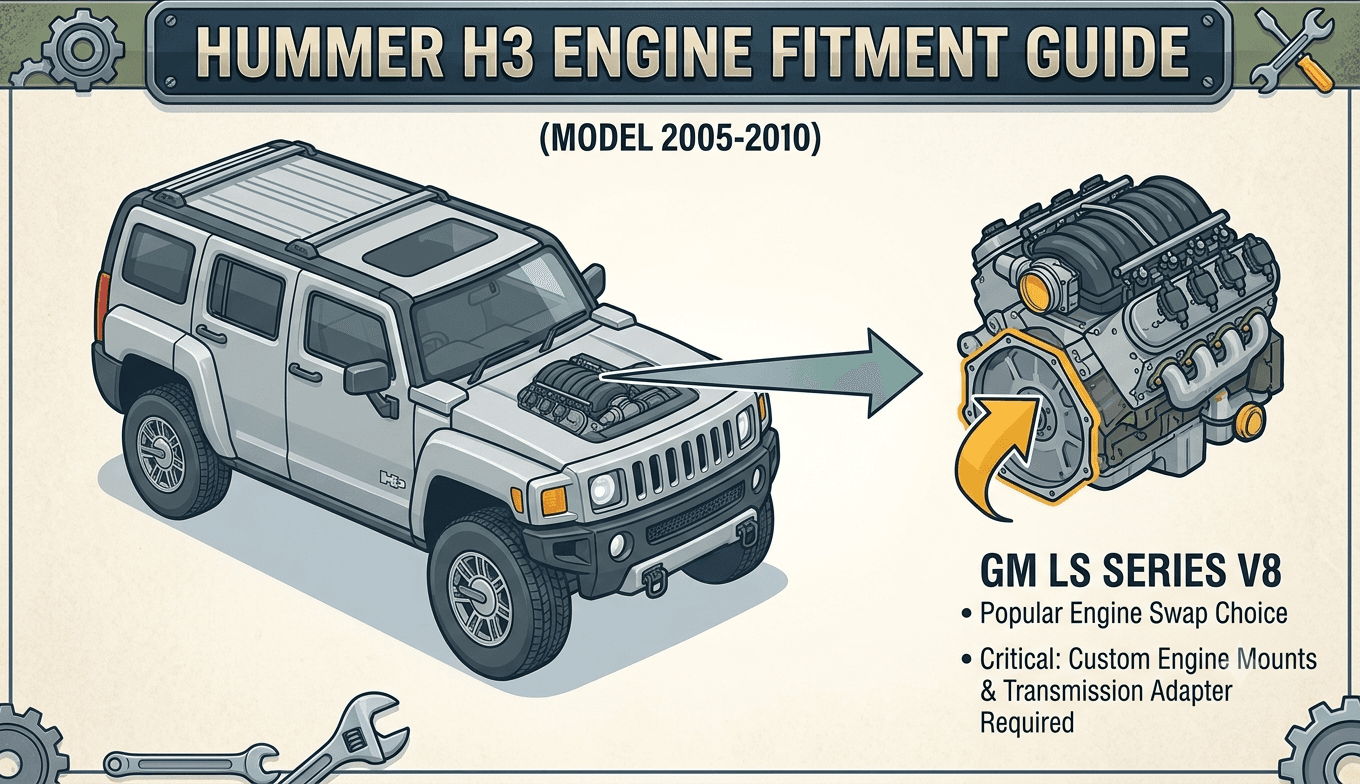
Hummer H3 Engine Fitment Guide, Used Engine Compatibility
Hummer H3 Engine Fitment Guide, Used Hummer H3 Engine, Hummer H3 Engine Compatibility, Hummer H3 Engine Replacement, Hummer H3 Engine Swap, Hummer H3 Used Engine for Sale, Hummer H3 Engine Interchange, Hummer H3 Engine Compatibility by Year

John Wilson
AutoParts Expert
Hummer H3 Engine Fitment Guide, Used Engine Compatibility
Hummer H3 Engine Fitment Guide, Used Hummer H3 Engine, Hummer H3 Engine Compatibility, Hummer H3 Engine Replacement, Hummer H3 Engine Swap, Hummer H3 Used Engine for Sale, Hummer H3 Engine Interchange, Hummer H3 Engine Compatibility by Year
Hummer H3 Engine Fitment Guide - What Actually Fits Before You Buy a Used Engine
Buying a used engine for a Hummer H3 is not as simple as matching displacement numbers. Two engines with the same "3.7L" badge can still refuse to run correctly in a swap because of PCM differences, sensor placement, or transmission pairing. This guide breaks down what actually fits, what needs adapting, and what to check before you hand over money for a used H3 engine.
The Hummer H3 was built with three factory engine options across its 2006–2010 run: a 3.5L inline-5 (2006 only), a 3.7L inline-5 (2007–2010), and a 5.3L Vortec V8 (2008–2010, Alpha trim only). The safest used-engine purchase is one from the same model year as your H3. Cross-year swaps within the same engine family are possible but usually require PCM reprogramming and sensor changes; crossing between the 3.5L, 3.7L, and 5.3L families requires a full swap kit, not a direct bolt-in.
Why "Same Displacement" Doesn't Always Mean "Direct Fit"
This is where most used-engine buyers get tripped up. Engine control hardware changed multiple times during H3 production, even while displacement stayed the same:
2007 3.7L engines used a one-year-only PCM (powertrain control module) with no separate TCM (transmission control module).
2008 and later 3.7L engines moved to a redesigned PCM and added a dedicated TCM.
2009 engines use different sensor types than 2007 units, including a different crankshaft position sensor.
So a "3.7L for 3.7L" swap between, say, a 2007 and a 2009 H3 will run but only after reprogramming the PCM and swapping in year-correct sensors. It's not a pull-and-drop replacement.
Inline-5 to Inline-5 Swaps (3.7L Cross-Year Compatibility)
If you're sourcing a used 3.7L for a 3.7L H3, here's what to plan for:
Same year to same year: closest to a direct fit. Lowest risk of electrical mismatches.
Adjacent years (e.g., 2008 into 2009): generally workable, but budget time for sensor verification and PCM calibration.
2007 paired with 2008+: Expect the most friction, since the PCM/TCM architecture changed that year. You may need to retain certain 2007-specific sensors (like the crank position sensor) even when using a later engine.
Whenever crossing model years, plan on reprogramming the PCM for the replacement engine and cross-checking sensor part numbers rather than assuming compatibility.
3.5L vs. 3.7L: Why These Aren't Interchangeable
The 3.5L (2006 only) and 3.7L (2007–2010) share a family resemblance but aren't a straight swap. Differences in internal architecture and engine control mean a 3.5L-to-3.7L (or reverse) swap needs:
A matching ECU calibrated for the replacement engine
The correct wiring harness for that engine's sensor layout
Verification of motor mount and accessory bracket compatibility
Treat this as an engine swap project, not a like-for-like replacement.
5.3L V8 (Alpha) Fitment Notes
The 5.3L Vortec V8 was never offered outside the Alpha trim, and it doesn't share a platform with the inline-5 engines in any meaningful bolt-in sense. If you're considering a V8 swap into an inline-5 H3 (a popular enthusiast project), be aware you're looking at:
Different motor mounts
A different transmission (4-speed automatic only no manual V8 option existed from the factory)
Different driveshaft length and possibly different transfer case gearing
A completely different wiring harness and ECU
Increased cooling system demands
This is a well-documented swap in H3 enthusiast circles, but it requires a proper swap kit and isn't something to attempt with just a used engine and a hoist.
Checklist Before Buying a Used H3 Engine
Confirm the engine's model year matches your H3, or is as close as possible
Ask the seller for the PCM/ECU included with the engine, not just the block
Verify crankshaft position sensor and other year-specific sensors are included or sourced separately
Check whether a TCM is required (2008+) or absent (2007)
Confirm motor mount and accessory bracket compatibility if crossing displacement classes
Factor in emissions compliance for your state if the engine is a different model year
Inspect cooling system capacity, especially for any V8 swap
Common Fitment Mistakes to Avoid
Assuming "3.7L" means universal compatibility across all H3 years without checking PCM/TCM differences.
Buying just the long block and expecting the harness and sensors from your old engine to work without modification.
Skipping PCM reprogramming after a cross-year swap, which often shows up later as check-engine lights or drivability issues.
Underestimating cooling and mount changes in V8 swaps.
Need the Right Part?
Get a free, no-obligation quote from AutoKing specialists.
Frequently Asked Questions
The Hummer H3 came with three factory engine options: 3.5L Inline-5 (2006) 3.7L Inline-5 (2007–2010) 5.3L Vortec V8 (2008–2010 Alpha models only)
Yes, but it is not a direct bolt-in replacement. You'll likely need PCM reprogramming, compatible sensors, and verification of the transmission control setup because the 2007 model uses a different control architecture.
No. Although both are inline-five engines, they use different engine management systems, wiring, and calibration. Swapping between them requires ECU, wiring harness, and compatibility modifications.
No. The 5.3L Vortec V8 was available only in the H3 Alpha. Installing it in an inline-five model requires different motor mounts, transmission, wiring harness, ECU, cooling components, and other supporting modifications.
Matching the model year minimizes compatibility issues with the PCM, sensors, emissions equipment, and transmission controls, making installation easier and reducing additional costs.
Still have questions?
Our specialists are ready to help — no bots, no scripts.