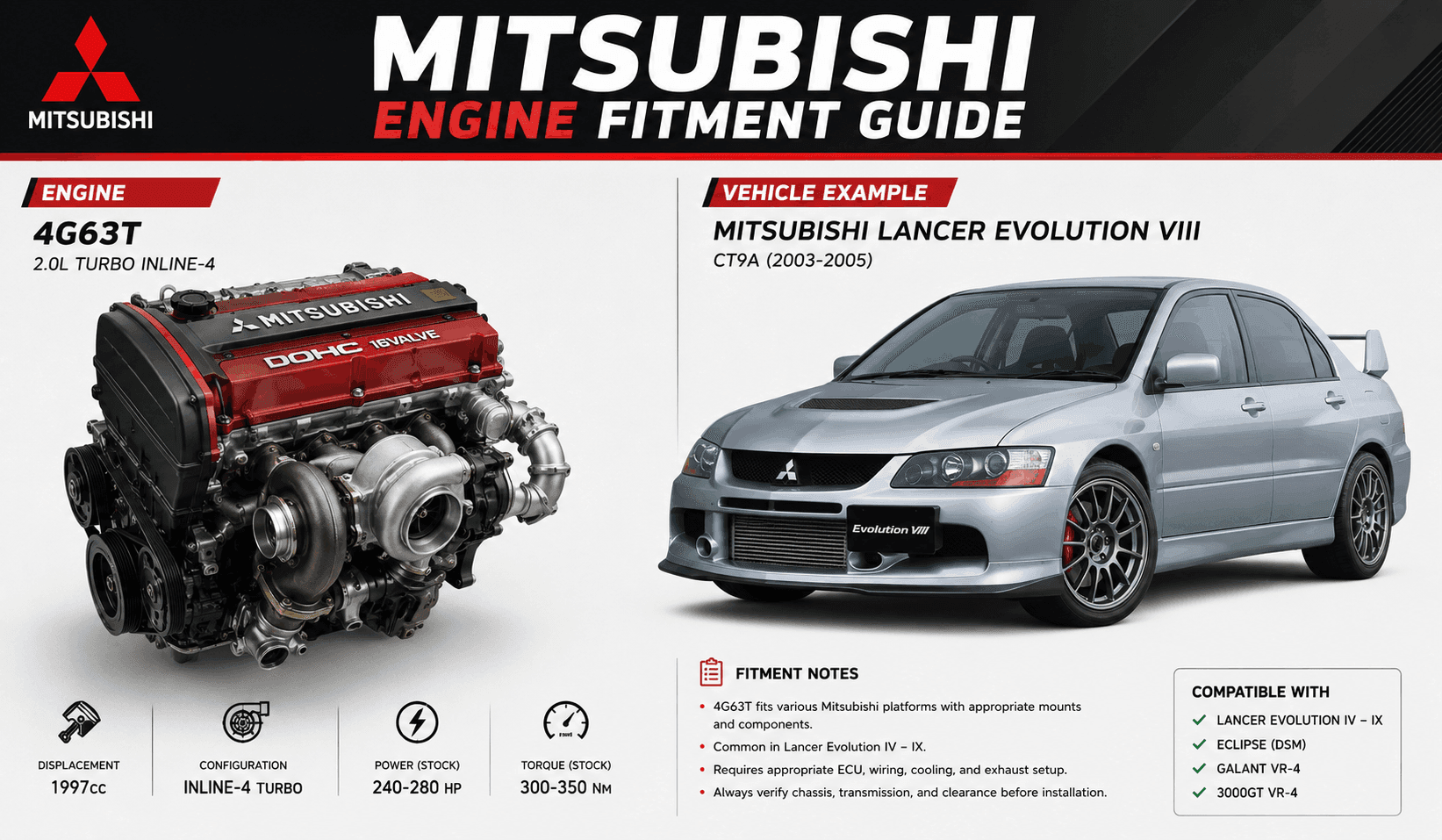
Mitsubishi Engine Fitment Guide | Find the Right Used Mitsubishi Engine
Mitsubishi vehicles reuse the same engine codes across many unrelated models and years, so matching by model name alone often leads to the wrong part. This guide explains how Mitsubishi's engine code system works cylinder count, fuel/block type, model suffix, and turbo/revision letters so you can decode any stamp on the block. It covers the major engine families (4G1x, 4G6x, 4G9x, 4B1x, diesel 4Dxx/4M4x, and V6 6Gxx/6Axx) and which vehicles they typically powered. It stresses cross-checking the engine code with the chassis code and production date, since the same generation of a model can carry different engines by market and trim.

John Wilson
Autoparts Expert
Mitsubishi Engine Fitment Guide | Find the Right Used Mitsubishi Engine
Mitsubishi vehicles reuse the same engine codes across many unrelated models and years, so matching by model name alone often leads to the wrong part. This guide explains how Mitsubishi's engine code system works cylinder count, fuel/block type, model suffix, and turbo/revision letters so you can decode any stamp on the block. It covers the major engine families (4G1x, 4G6x, 4G9x, 4B1x, diesel 4Dxx/4M4x, and V6 6Gxx/6Axx) and which vehicles they typically powered. It stresses cross-checking the engine code with the chassis code and production date, since the same generation of a model can carry different engines by market and trim.
Mitsubishi Engine Fitment Guide - How to Match the Right Engine to Your Vehicle
Buying a used Mitsubishi engine, or trying to figure out what's actually bolted under your hood, is trickier than it should be. Mitsubishi has reused engine families across dozens of models over five decades, swapped displacements mid-generation, and shared platforms with Chrysler, Hyundai, and Dodge. That means two cars with the same badge can carry completely different engines depending on the year and market they were sold in.
This guide breaks down how Mitsubishi's engine codes work, which families fit which vehicles, and how to confirm a fitment before you buy a replacement engine, order parts, or plan a swap.
How Do I Know Which Engine Fits My Mitsubishi?
The fastest way to confirm fitment is to match three things at once: the engine code stamped on the block, your vehicle's chassis code, and the model year. Mitsubishi's engine code alone is not enough, because the same code (like 4G63 or 4D56) was fitted across multiple unrelated models over a 20+ year span, often with different mounts, ECU wiring, and accessory layouts. Always cross-check the code against your VIN or chassis plate rather than relying on the model name and year alone.
How Mitsubishi Engine Codes Are Structured
Mitsubishi's naming system looks cryptic at first, but it follows a consistent pattern once you know what each part means.
First digit: number of cylinders (4 for inline-four, 6 for V6)
Letter: engine family/fuel type: G for gasoline with an iron block, B for gasoline with an aluminum block, D for diesel, M for larger diesel units
Two-digit suffix: identifies the specific engine model within that family (this number does not directly equal displacement a 4G64 is larger than a 4G93 despite the lower number)
Trailing letter: optional suffix such as T for turbocharged or B for a revised second version (for example, 4G63T)
On later engines using the shortened code without the leading cylinder digit, you might see a code like G63T stamped instead of 4G63T both refer to the same unit.
Mitsubishi Engine Families and Common Fitments
4G1x "Orion" Series (1.2L–1.6L)
Small displacement engines built for economy cars. The 4G13 (1.3L) and 4G15 (1.5L) were common in the Colt and Mirage lineups through the 1990s and early 2000s, typically paired with 12-valve or 16-valve cylinder head variants depending on the trim.
4G6x "Sirius" Series (1.6L–2.4L)
This is Mitsubishi's best-known performance family. The 4G63 (2.0L) is the engine most associated with the brand, having powered the Galant, Eclipse, and in its most developed turbocharged form the Lancer Evolution through its WRC-winning era. The naturally aspirated version also appeared in the Delica van and Pajero/Montero in some markets. The related 4G64 (2.4L) shares the same architecture but with a larger bore and was fitted to the Outlander, Galant, and larger Delica variants.
Because the 4G63 spans naturally aspirated SOHC economy versions and DOHC turbocharged performance versions, confirming which sub-variant you have (by checking cam configuration and turbo hardware, not just the code) is essential before ordering internals or gaskets.
3. 4G9x Series (1.5L–2.0L)
A more modern family featuring MIVEC variable valve timing on several variants. The 4G93 was notable as one of the first mass-produced GDI (gasoline direct injection) engines, used in the Carisma, Lancer, and Mirage. The 4G94 (2.0L SOHC) later appeared in Lancer models sold in markets like the UK.
4. 4B1x Series (2.0L–2.4L)
Developed jointly with Hyundai and Chrysler under the Global Engine Manufacturing Alliance (GEMA), these all-aluminum, MIVEC-equipped engines replaced the older iron-block fours. The 4B11 (2.0L) and 4B12 (2.4L) fitted the 2007-onward Lancer and Outlander, and the 4B11 later found its way into the Lancer Evolution X and the RVR/ASX/Eclipse Cross depending on market.
5. 4Dxx and 4M4x Diesel Series
Mitsubishi's diesel lineup covers light passenger applications through to heavy trucks. The 4D56 (2.5L turbodiesel) is one of the most widely fitted diesel engines in the brand's history, appearing across generations of the Pajero/Montero/Shogun, Triton/L200 pickup, and Delica. The larger 4M40 and 4M41 (around 2.8L–3.2L) served heavier-duty applications in later Pajero, Triton, and Challenger/Pajero Sport models.
6. 6Gxx and 6Axx V6 Series
Mitsubishi's six-cylinder engines cover the 3000GT/GTO, Galant VR-4, Diamante, Pajero, and Montero. The 6G72 (3.0L) is the most common, ranging from a modest naturally aspirated tune to the twin-turbo version used in the 3000GT VR-4. The 6G74 (3.5L) and 6G75 (3.8L) scaled displacement up for later Pajero, Montero, and Endeavor applications, while the compact 6A12 (2.0L) and 6A13 (2.5L) V6 units among the smallest mass-produced V6 engines ever built powered the FTO and later-generation Galant VR-4.
Chassis Code vs. Engine Code Why Both Matter
Mitsubishi identifies vehicle generations by chassis code (for example, the Pajero's L040-series or the Triton's K-series and KA/KB-series), and the same chassis code often spans multiple engine options across trims and export markets. A Pajero from the L040 generation, for instance, could have left the factory with a G63B petrol four, a G54B, a 4D55 diesel, or a 4D56 diesel depending on trim and destination market. This is exactly why relying on the model name and year alone leads to mismatched parts — two Pajeros from the same year can carry entirely different engines.
When sourcing a replacement engine or verifying fitment, check:
The engine code stamped on the block (usually near the block-to-transmission mating surface or on a machined pad on the block itself)
The chassis code on your VIN plate, not just the model name
Production date range, since engine options frequently changed mid-generation
Transmission and drivetrain pairing (2WD vs 4WD variants often used different engine tunes even within the same chassis code)
Common Fitment Mistakes to Avoid
Assuming model year alone guarantees a match. Export markets received different engines under the same model name and year.
Ignoring SOHC vs. DOHC differences. Engines sharing a code (like 4G63 or 4G64) came in both configurations with different heads, cams, and in some cases different mounting points.
Overlooking the trailing letter. A 4G63 and 4G63T are not interchangeable without addressing turbo plumbing, ECU tuning, and often the oil system.
Mixing up regional diesel variants. The 4D56 saw multiple revisions (mechanical injection vs. common rail) that are not always interchangeable despite sharing the same base code.
Need the Right Part?
Get a free, no-obligation quote from AutoKing specialists.
Frequently Asked Questions
The 4G63 (2.0L four-cylinder) is arguably the most widely recognized, having powered everything from economy Galants to the turbocharged Lancer Evolution.
No. The 4D56 was produced across multiple generations, including older mechanical-injection versions and later common-rail versions. They are not universally interchangeable, so always confirm the specific revision before purchasing.
Sometimes, since they share the same basic block architecture, but mounting points, wiring harnesses, and ECU calibration can differ by model and year, so this needs case-by-case verification rather than a blanket assumption.
It's typically stamped directly on the engine block near the bellhousing, and it's also usually listed on the vehicle's compliance or VIN plate alongside the chassis code.
Not reliably. The two-digit suffix identifies the specific engine model, not displacement directly some higher-numbered codes are actually smaller than lower-numbered ones within the same family.
Still have questions?
Our specialists are ready to help — no bots, no scripts.